Quality Control Checkpoints for Decorated Perfume Bottles
Decoration quality is decided before the run starts, by whether anyone wrote down what a defect is. A bottle with a print two millimetres off centre is a fault in one specification and a pass in another, and the difference is a number agreed in advance rather than an opinion formed on the day. The checkpoints below are ordered as the product moves: incoming components, first-off approval, in-process inspection, final inspection and retained samples. Each one is cheap. The rework that follows a missing checkpoint is not.
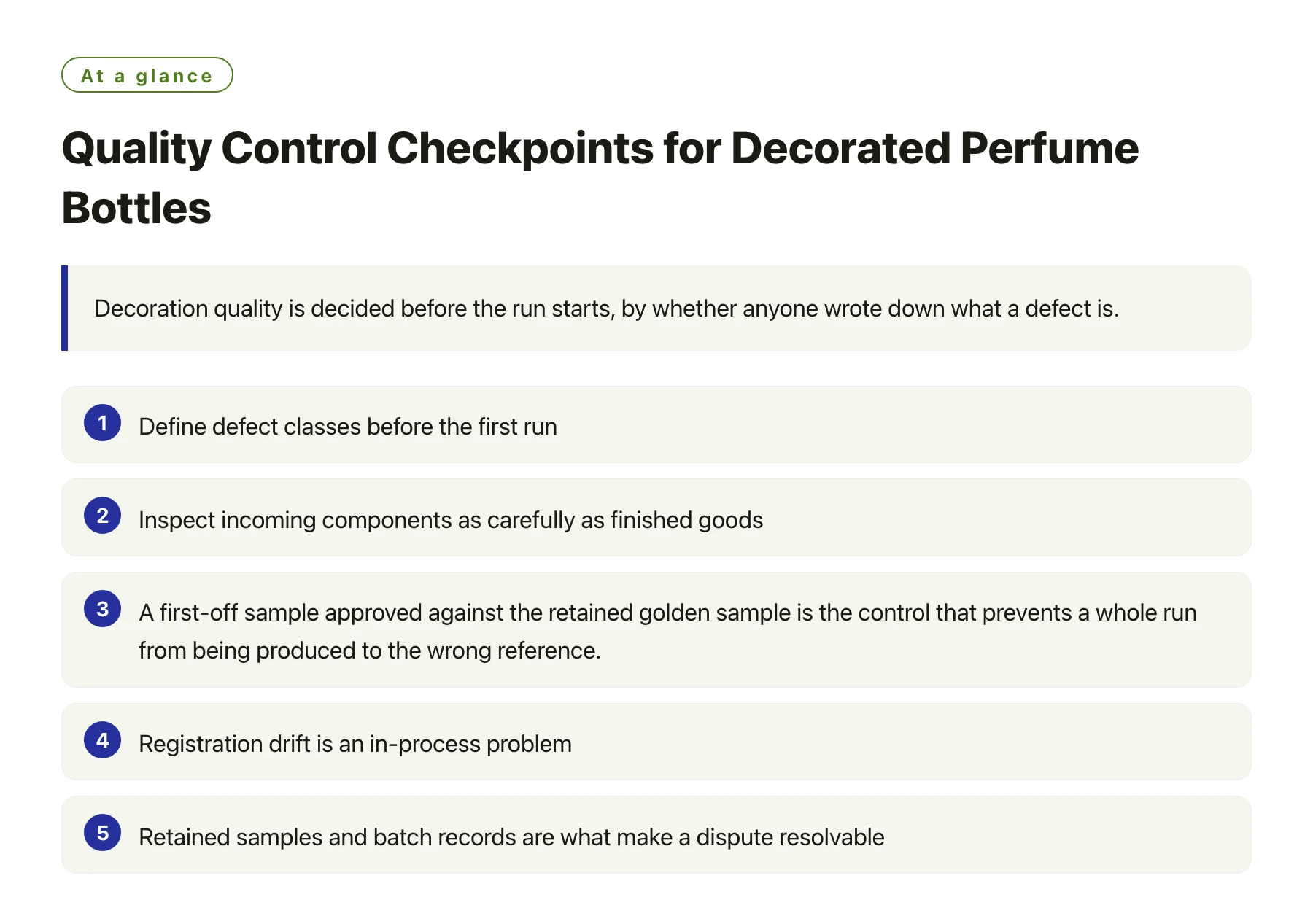
Key takeawaysDefine defect classes before the first run, so that critical, major and minor are agreed rather than argued about at final inspection. · Inspect incoming components as carefully as finished goods, because glass variation and colour differences between cap and bottle are the most common decoration defects. · A first-off sample approved against the retained golden sample is the control that prevents a whole run from being produced to the wrong reference. · Registration drift is an in-process problem, so inspection frequency has to be set by how fast the line runs, not by the size of the order. · Retained samples and batch records are what make a dispute resolvable; without them, an argument about a defect has no evidence on either side.
Decorative defects are unlike fragrance defects in one important way: they are visible to the consumer immediately. A scent that is slightly off may still sell. A label printed crooked, a foil that has scuffed in the carton or a cap that does not match the bottle reads as poor quality before the product is even opened.
That makes decoration inspection worth specifying properly rather than leaving to a visual check at the end. The following walk-through is written from the quality side of the table and assumes a production run large enough that sampling makes sense.
Nothing here is exotic. It is the set of controls that experienced decorators already use and that buyers should confirm exist.
Before the run: components, materials and definitions
Most decoration failures originate in something that arrived before the decorating line started. Glass that varies in colour, a cap moulded in a slightly different shade, a foil batch that transfers at a different temperature. Catching those at goods-in is far cheaper than catching them assembled.
It is also the stage where the specification gets tested for the first time. If the acceptable shade range is not written down, the incoming inspector has to invent one.
Incoming component inspection
Check glass for mould seams, bubbles, cracks, dimensional variation and surface coating consistency. Check caps, collars and pumps for function, fit and shade against the approved reference. Record what was inspected, in what quantity, and against which revision of the specification, because an inspection without a record cannot be audited later.
Consumables and raw materials
Inks, foils, coatings and adhesives have batch numbers and shelf lives. Incoming checks should confirm the material matches the approved type and is within date, which is the same discipline applied to fragrance materials, where a specification is tied to defined material data [1]. A decorator who cannot say which foil batch is on the machine cannot investigate a transfer problem afterwards.
Agree the defect definitions in writing
Classify defects by severity before production: critical for anything that breaches safety or a market requirement, major for a visible fault a customer would reject, minor for a variation within the agreed tolerance. Then set an acceptance level per class. This is standard inspection practice in cosmetics manufacturing, and it is the difference between an inspection and a preference [2].
Checkpoints to write into the decoration specification
- First-off approvalThe first decorated unit compared against the retained golden sample for colour, position, coverage and finish; the run does not proceed until it passes.
- Tooling conditionScreens, dies and plates inspected for damage or wear at the start of the run, so a known tooling fault is not mistaken for a process drift.
- Registration check at start-up, middle and endPosition measured against the tolerance that was agreed, recorded with the time it was taken.
- In-process inspection at a defined frequencyFrequency set by line speed and defect history, not by order size, with results recorded rather than remembered.
- Cure and handling controlDwell time and racking defined so that freshly decorated components are not stacked or packed while the ink or coating is still vulnerable.
- Final inspection against an acceptance levelSampling by class of defect, with critical defects treated as a stop condition rather than a percentage.
- Retained samples and batch recordOne decorated unit per batch retained by both parties, labelled with date, batch, artwork revision and the operator reference.
After decoration: the checks that involve the product
Decoration is not finished when the bottle looks right. The next steps are filling, assembly and packing, and each of them can damage a finish that passed inspection a day earlier.
This is the stage where control over the whole sequence pays for itself, because the party who decorated the bottle is also responsible for how it is handled afterwards. That continuity is a common reason buyers choose a supplier that runs a factory that handles fragrance R&D and production rather than a decorator and a filler working to two separate specifications. Where one organisation holds design, filling and inspection under a single quality system, as a full-scope supplier such as Xuelei fragrance house does, the post-decoration checks become enforceable rather than advisory.
The checks worth adding after filling are straightforward: leakage and seal integrity, pump or spray function, cap torque, and a visual check of the decorated surface after cartoning. Packing material is a frequent culprit, because a tight fit that protects the bottle in transit can also abrade a foil edge.
Artwork and version control on the line
Confirm that the artwork revision on the line matches the one in the purchase order, including carton and leaflet. Version errors are the quietest defect in packaging: the product looks perfect and is still wrong. This is the same control that keeps a market's labelling requirements intact, and it is covered in more depth in the material on Xuelei's guide.
What a good batch record contains
Material lots and their certificates, process settings, inspection results with times, the artwork revision used, quantity produced, quantity rejected, and the retained sample reference. If the formula is subject to the IFRA Standards, the record should also show the conformity statement version it was produced against, since limits are revised periodically [3]. A record that answers all of that in one document is worth more than any number of reassurances.
Write the inspection plan before the first purchase order and attach it to the specification. The plan does not need to be long: what is checked, against what reference, how often, by whom, and what stops the line. A four-line plan that exists beats a comprehensive one that is agreed verbally and never written down.
Sources
- The Good Scents Company —— A reference database of aroma materials with odour descriptions, CAS numbers and typical usage information.
- SGS: Cosmetics, Personal Care & Household Testing —— Testing, inspection and certification services for cosmetics and personal care, including microbiological, stability and safety testing aligned with cosmetics GMP.
- IFRA Standards Library (International Fragrance Association) —— The IFRA Standards Library lists the restrictions the fragrance industry applies to individual fragrance ingredients, based on safety assessments; it is the reference point for compliant fragrance formulation.
Frequently asked questions
What is the most common decoration defect at volume?
Registration drift, followed by colour variation between components. Both are process and material issues rather than design faults, which is why first-off approval and a defined inspection frequency catch most of the volume problems.
Do I need to inspect every bottle?
Usually not. Inspection is normally done by sampling against an agreed acceptance level, with critical defects treated as a stop condition. For a new artwork or a new component, a tighter inspection for the first batch is a sensible exception.
Who should hold the golden sample?
Both parties, each with a sealed and labelled unit. A single sample held by the manufacturer is not a control, because the brand has nothing to compare against when a dispute arises.
Should decoration inspection happen before or after filling?
Both. Decoration should be inspected before filling so defective units are removed early, and the decorated surface should be checked again after filling and cartoning, because handling is where scuffs and abrasion appear.
What should be in the inspection record?
The reference used, the revision number, the sample size, the defects found by class, the time of the check and the person who performed it. Without those five elements, the record cannot support a decision later.